
The Oval Plaza
I still remember walking into this space for the first time. It’s not actually a circle—it’s egg-shaped, which somehow makes it even more striking. Those 56 Ionic columns rise around you, and suddenly you’re standing in what used to be the city’s main gathering spot 2,000 years ago.
The scale messes with your head in the best way. I kept circling the plaza, trying different angles, because every view felt like a postcard.
[PHOTO TIP]: Golden hour is non-negotiable here. The warm light turns the limestone into honey. Shoot wide and low—get the columns framing the plaza. I had my travel buddy walk through to show just how massive this place really is.
The South Gate
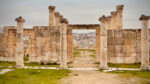
This gate stopped me in my tracks before I even entered the main site. Three arches, intricate carvings, and this sense that you’re about to walk into something important. I loved how the weathered stone catches light differently throughout the day. Every crack and carving tells a story.
[PHOTO TIP]: Step way back with a wide lens to capture the full height. The archways make perfect natural frames—stand inside them and shoot out. I got my favorite shot from a low angle, looking up, which made the gate feel even more imposing.
The Temple of Artemis
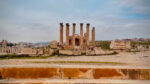
Eleven Corinthian columns still standing, dedicated to Jerash’s patron goddess. When I climbed up to the temple platform, the view stretched across the entire site.
What got me was how delicate those column capitals are—after all this time, you can still see the carved acanthus leaves clearly.
[PHOTO TIP]: Climb the steps to the side and shoot down for a completely different perspective. That blue Jordanian sky against the warm stone is chef’s kiss. Get close to one column and shoot the details of the capitals—they’re miniature works of art.
The Colonnaded Street (Cardo Maximus)
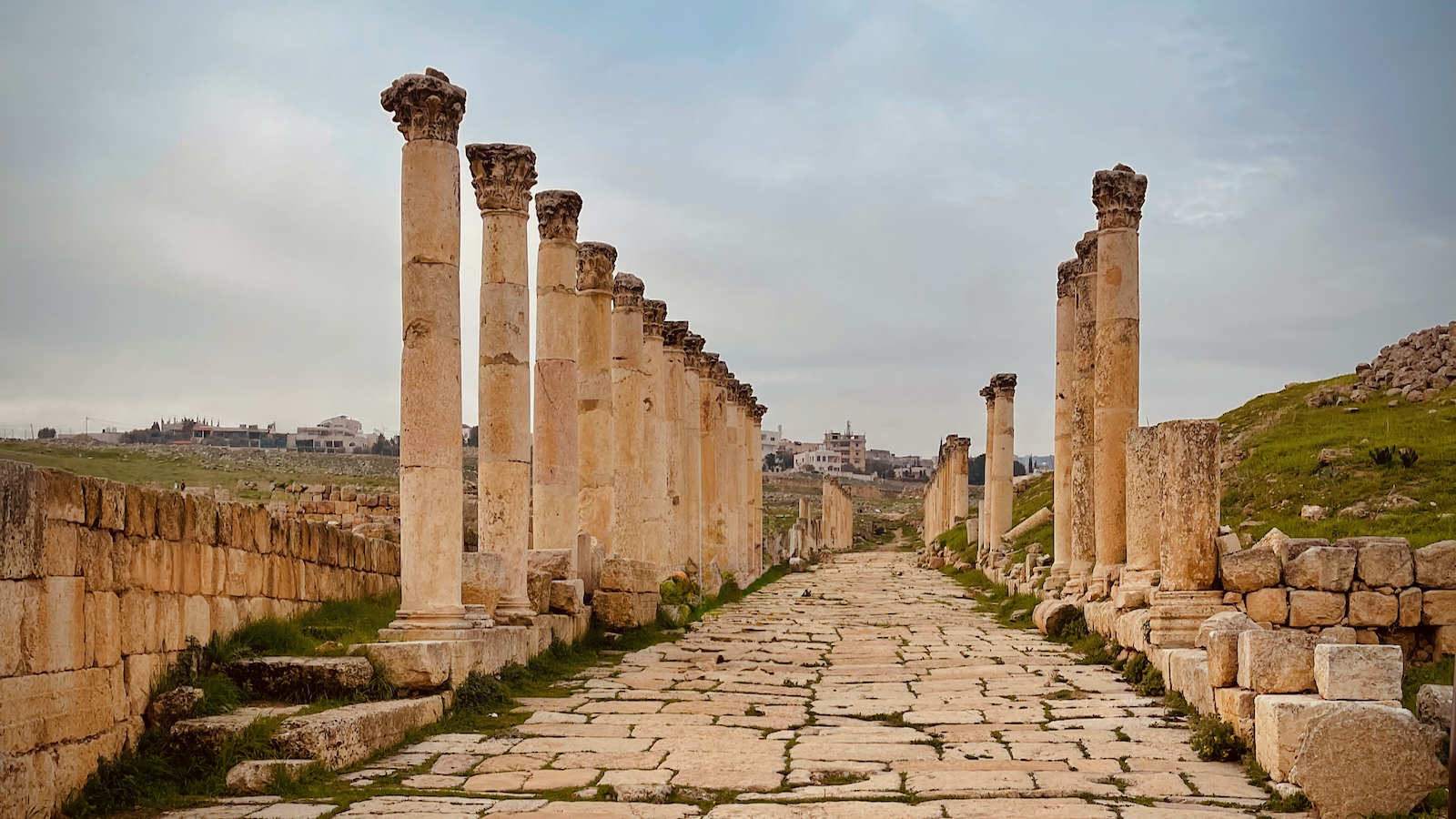
Half a mile of original Roman paving stones, worn smooth by centuries of footsteps and chariot wheels. Columns line both sides like they’re standing guard over the road.
I walked this street three times—once in harsh midday sun, once at golden hour, once in the morning shadows. Each time felt completely different. The worn grooves in the stones from ancient chariot wheels? That’s the detail that made history feel real to me.
[PHOTO TIP]: Don’t shoot straight down the middle—find sections where columns are broken or arches create gaps for more interesting compositions. Use a wide aperture to blur the endless columns in the background. The perspective play here is unreal.
The South Theatre
Carved directly into the hillside. I sat in the top row for a good ten minutes, just looking down at the stage and imagining what performances happened here.
The acoustics still work—people were testing it out, and you could hear a whisper from the stage perfectly. The curved rows create these beautiful leading lines no matter where you shoot from.
[PHOTO TIP]: Climb to the top for the full panoramic sweep. Or stand on the stage and shoot up at the seating—it’s dizzying. Late afternoon shadows create dramatic patterns across the stone rows.
Hadrian's Arch
Built in 129 AD when Emperor Hadrian rolled through town. It stands alone outside the main ruins, and honestly, I almost skipped it. Glad I didn’t. The triple-arched gateway is partially reconstructed, but it still has this commanding presence that makes you slow down.
[PHOTO TIP]: Shoot through the central arch to frame the ruins in the distance—instant depth. Put someone under the arch for scale (it’s taller than you think). Golden hour light hits the carved details just right.
The Nymphaeum
The fancy public fountain that used to be the city’s water feature and social hub. It’s mostly in ruins now, but the carved niches and decorative elements hint at how elaborate it must have been. I spent time here because everyone else rushes past to the bigger monuments. The details reward patience.
[PHOTO TIP]: Get tight on the carvings and stonework—tell the story through details rather than the whole structure. Shallow depth of field works beautifully here. If there’s any water pooled in the base, catch those reflections.
Don't Miss the Small Stuff
I’m serious about this: some of my favorite shots from Jerash aren’t the big monuments. Look for:
- Mosaic floors tucked into side rooms—geometric patterns still intact
- Water channels carved into the streets (the Roman engineering nerd in me loved these)
- Inscriptions in Greek etched into random stones
- Wildflowers growing through cracks in 2,000-year-old stones
- Shadows and textures on the worn limestone
These details made my feed feel less like everyone else’s Jerash photos and more like my own story.