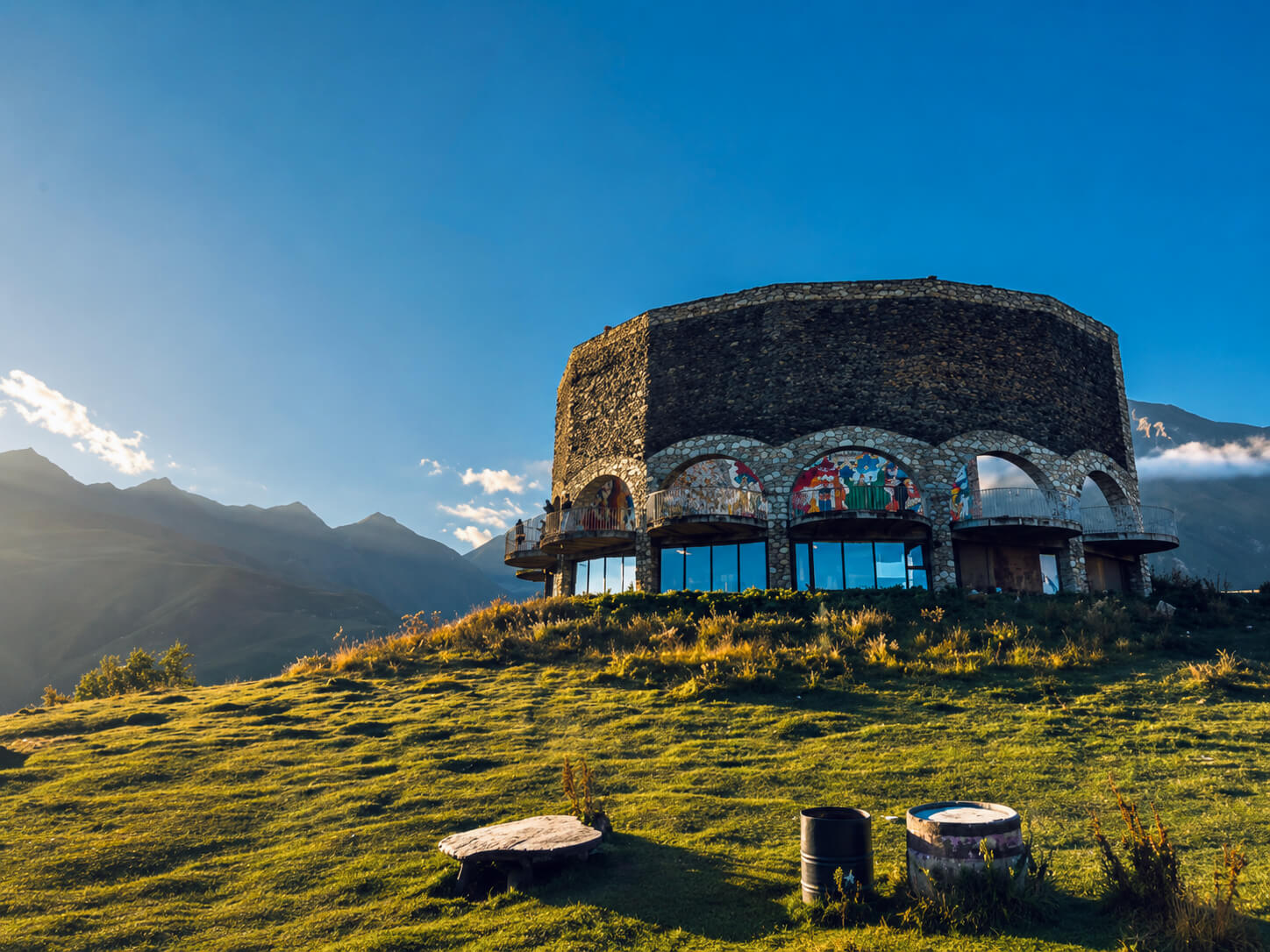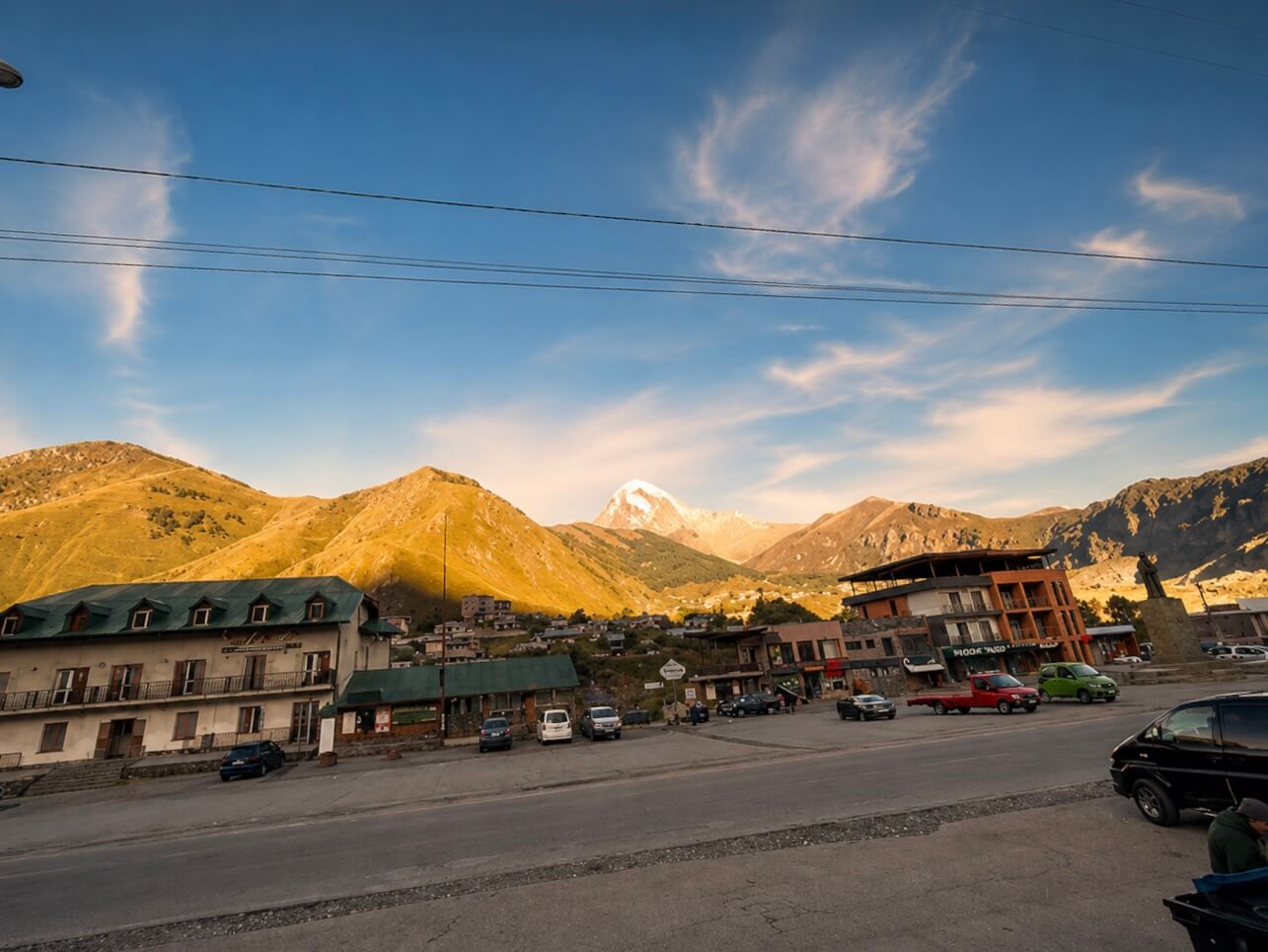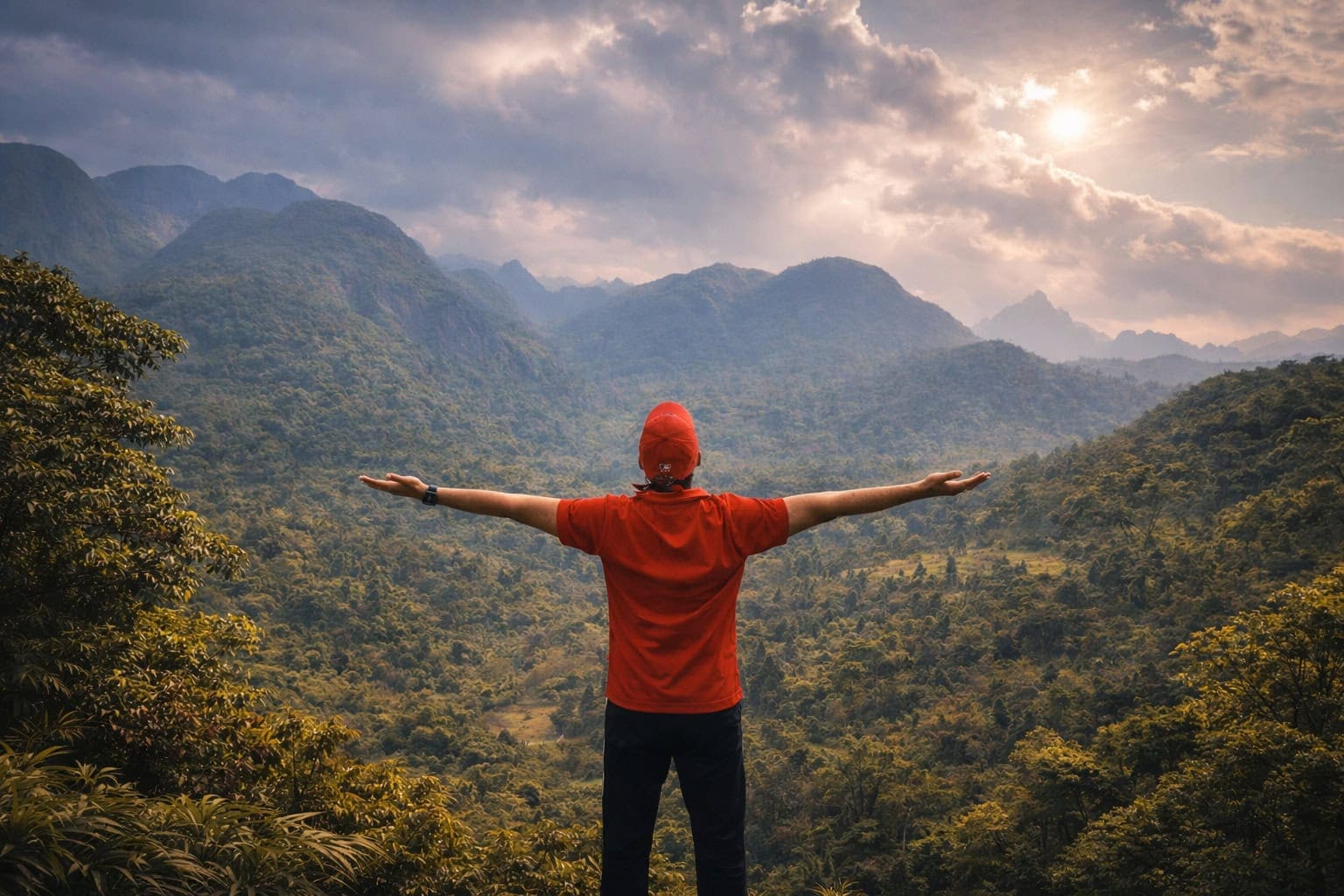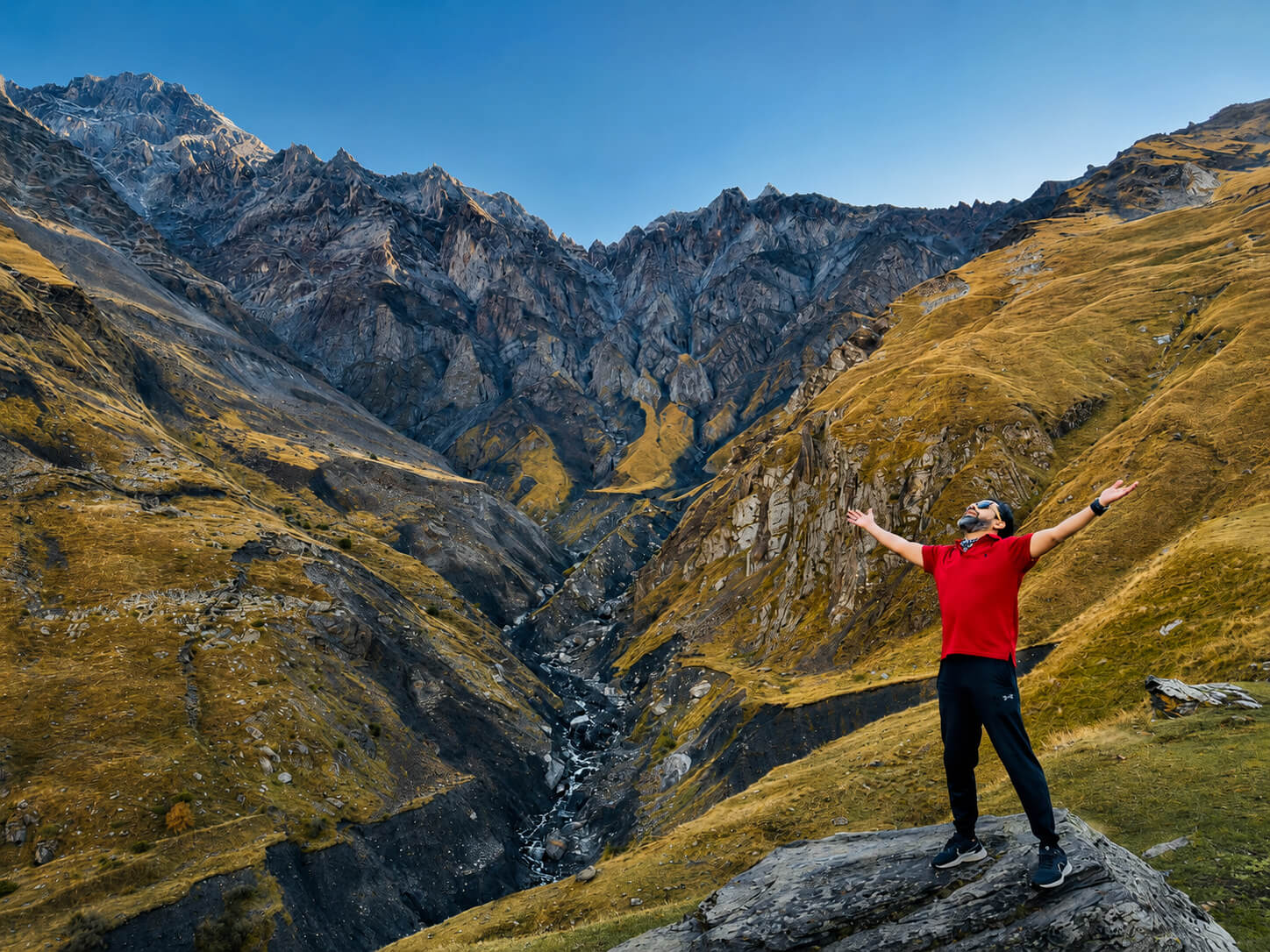

I’ve been to Kazbegi twice and I still haven’t gotten every shot I wanted. Not because the places aren’t there. Because Kazbegi is a destination where the light, the season, and the weather all have to align differently for each location. This guide to the most instagrammable places in Kazbegi is honest about that. Some spots need snow. Some need summer green. Some need a dry riverbed and some need a full waterfall. You’re not getting all of it in one trip.
Gergeti Trinity Church: The Shot Everyone Comes For and Why Timing Changes Everything
- Best light: Golden hour, 6:00–7:30am in summer. Blue hour after sunset also works.
- Best season: Two completely different shots — snow-covered in January to March, green valley in June to August
- Crowd window: Before 8am or after 6pm. Between 10am and 4pm the viewpoints are busy.
- Outfit tip: Deep colors — burgundy, navy, forest green — read well against both the grey stone and the mountain snow behind
The Gergeti Trinity Church sits at 2,170 meters with Mount Kazbek rising directly behind it. In winter, the whole ridge is white and the church looks like it’s been placed there by someone who understood composition. In summer, the foreground is deep green and the mountain still holds snow at the top. Both versions are worth coming for. The mistake most people make is arriving mid-morning in July and shooting into flat overhead light with thirty other people in the frame.
Tip
- Position: Shoot from the valley floor looking up for the classic wide frame. The viewpoint near Rooms Hotel gives you the church with the full Kazbek backdrop.
- Angle: A wide lens at 16–24mm captures the scale. A 50mm or short telephoto compresses the mountain behind the church and makes it look even larger.
- Winter note: The 4×4 track to the church is often impassable in deep snow. The shot from the valley is better anyway in winter.
Rooms Hotel Kazbegi Terrace: The Framed View Without the Hike
- Best light: Late afternoon, 4:00–6:30pm — light hits the church face directly
- Best season: Year-round. Snow version in winter is exceptional.
- Crowd window: Weekday mornings are quietest. Weekend afternoons get busy with day-trippers.
- Outfit tip: White or cream reads cleanly against the stone terrace and mountain backdrop
The hotel terrace sits on a raised platform above town and gives you the church and Kazbek in one unobstructed frame without walking up to the church itself. The terrace railing is clean stone, the foreground is tidy, and the mountain fills the background completely. It’s the most composed shot in Kazbegi that doesn’t require a hike. I’ve seen this image taken in January with full snow cover and it looks like a different country entirely.
Tip
- Position: Stand at the far left of the terrace facing the church — this angle Avoids the hotel building on the right edge of the frame
- Angle: Slightly elevated position works best. The terrace has a low stone wall you can shoot over cleanly.
- Extra: Order coffee and stay for the light change. The 20-minute window before sunset turns the mountain face orange.
Juta Valley: The Green Shot That Needs the Right Month
- Best light: Midday actually works here — the valley is open and light fills it evenly
- Best season: July and August. The valley floor is at peak green. Before June or after September the grass is dry and brown.
- Crowd window: Before 10am. Most day-trippers arrive late morning.
- Outfit tip: Bright colors — yellow, red, orange — contrast sharply against the green valley and grey Chaukhi rock towers
Juta Valley has a specific look that only exists in a six-week window in midsummer. The valley floor goes a green that seems too saturated to be real, the Chaukhi massif rises at the far end in grey and brown rock towers, and the scale of the whole thing is hard to capture in a single frame. If you go in September the grass is already yellowing. If you go in May the road may not even be open. July is the month for this one.
Tip
- Position: Walk 20 minutes past Juta village toward the Chaukhi base — the valley opens up and you get the full rock tower backdrop
- Angle: Low angle from the trail looking up toward Chaukhi gives the towers more height
- Extra: The shepherd huts in the mid-ground add scale and context to wide shots
Gveleti Waterfalls: The Shot That Disappears in Dry Season
- Best light: Midday — the gorge is narrow and only gets direct light for a short window
- Best season: May to July. Snowmelt keeps the falls powerful. By August the flow is already reducing. By September some years it’s barely a trickle.
- Crowd window: Early morning on weekdays
This is the shot that catches people out. The waterfall images you see online were taken in May or June when the snowmelt is still running hard. The lower fall sends spray ten meters out and the rocks around the base are soaked and dark green. Come in late August or September and you might find a thin stream running down damp rock. It’s still a nice gorge walk. It’s not the same photograph.
Tip
- Position: Stand at the base of the lower fall and shoot upward — the rock frame on both sides gives the image structure
- Angle: A slow shutter speed (1/4 to 1 second) smooths the water. Bring a small tripod or use a rock as a rest.
- Extra: A polarizing filter cuts the glare off the wet rocks and makes the greens much richer
Truso Valley: The Rust River Shot Nobody Talks About
- Best light: Morning, 8:00–10:00am — light comes over the eastern ridge and hits the valley floor
- Best season: June to September. The mineral springs flow year-round but the valley road is often closed by snow outside this window.
- Crowd window: Almost always quiet. This valley gets a fraction of the Gergeti visitors.
The Terek river running through Truso is rust-orange from the mineral content and it looks completely wrong in the best possible way. The contrast between the orange water, the grey rock walls of the gorge, and the green valley floor above is unlike anything else in the Kazbegi area. The travertine formations along the bank add texture to foreground shots. I spent two hours here and saw four other people.
Tip
- Position: Shoot from the bank looking downstream with the gorge walls framing both sides
- Angle: Low to the water surface makes the orange color more intense in the frame
- Extra: The abandoned Zakagori fortress on the ridge above adds a strong vertical element to wide landscape shots
Dariali Gorge: The Winter Shot That Most People Never See
- Best light: Midday in winter when the sun is low and light filters into the gorge
- Best season: January to March for ice and snow formations on the cliff walls. Summer gives you a different, greener version.
- Crowd window: Almost always quiet outside summer weekends
The gorge walls rise almost vertically on both sides of the road and in winter they develop ice formations that run in long vertical strips down the rock face. The Terek runs fast and dark at the bottom. Dariali Monastery is built directly into the cliff and in winter it sits behind a curtain of ice and snow in a way that looks genuinely medieval. This is a shot that requires a January or February trip and most people never make that trip.
Tip
- Position: Pull off the road at the monastery viewpoint and shoot with the gorge walls framing both sides of the frame
- Angle: A wide lens captures the full scale of the cliff walls. A longer lens isolates the monastery against the ice.
- Extra: Check road conditions before driving — The Georgian Military Highway through the gorge can be icy in deep winter
The Georgian Military Highway: The Road That Is the Shot
- Best light: Golden hour in either direction — sunrise driving north, sunset driving south toward Tbilisi
- Best season: Spring and autumn for cloud drama. Summer for clear peaks. Winter for snow-covered passes.
- Crowd window: Early morning before truck traffic builds
The road between Tbilisi and Kazbegi is one of the better drives in the Caucasus and several points along it are worth stopping for specifically. The Zhinvali reservoir early in the drive goes a deep turquoise in spring. The Gudauri plateau section opens into a wide highland landscape that feels nothing like the mountain gorges on either side. The Jvari Pass at 2,395 meters gives you a clear view back down the valley you came from. None of these are in Kazbegi itself but they’re on the way and they’re worth the stop.
Tip
- Pull off safely — the highway has limited shoulder in the gorge sections. Use designated viewpoints.
- The Gudauri plateau is at its best in autumn when the highland grass goes gold
- If you’re in a private transfer, ask the driver to stop at Zhinvali and Jvari Pass. Most will without hesitation.
Kazbegi Town at Dusk: The Shot That Requires You to Stay
- Best light: Blue hour, 20–40 minutes after sunset
- Best season: Year-round. Winter gives you snow-covered rooftops with lit windows. Summer gives you long dusk light.
- Crowd window: Almost no other photographers. Day-trippers are long gone by this point.
The town itself at blue hour is something that only people who stay overnight ever see. The guesthouse lights come on, the mountains go dark blue behind the church, and the main street empties out completely. It’s a quiet, specific kind of image that doesn’t look like a travel photograph. It looks like a place where people actually live. That distinction is visible in the photograph.
Tip
- Position: Find a slight elevation above the main street — the path up toward Rooms Hotel works — and shoot back down toward the church
- Angle: A longer exposure (2–8 seconds) captures the last sky color and the warm window light simultaneously
- Extra: A tripod is essential here. Handheld at blue hour in low light gives you nothing usable.
Arsha Village: The Unselfconscious Shot
- Best light: Morning, 7:00–9:00am — side light on the stone houses
- Best season: May to October. Spring brings wildflowers in the surrounding fields.
- Crowd window: Almost always empty of tourists
Arsha is 5 kilometers south of Kazbegi and almost nobody goes there with a camera. The village has traditional stone houses, a small medieval church, working fields, and the mountain rising behind it in a wider part of the valley. The images from here look nothing like the Gergeti shots everyone has. They look older and less deliberate and more honest about what this part of Georgia actually is.
Tip
- Position: Shoot from the lower edge of the village looking uphill toward the church with the mountain behind it
- Angle: Include a foreground element — a stone wall, a field, a gate — to give the image depth
- Extra: Walk rather than drive. The approach on foot along the river path gives you better angles than arriving by road.
The Honest Answer About Kazbegi Photography
You need at least two trips to get the full picture. Come in summer for Juta and the green valley shots. Come in winter for Dariali gorge, the snow-covered church, and the town at dusk. The waterfall needs May or June. Truso works in either season. Plan around that and you’ll stop being disappointed that you missed the shot — because you’ll know exactly which trip to come back for.