
The Chronicle of Georgia sits on a hillside in northern Tbilisi overlooking the Tbilisi Sea, and many visitors miss this hidden architectural marvel. Designed by Zurab Tsereteli, it’s a massive monument featuring 16 towering pillars covered in bronze and copper relief panels that detail the nation’s history and religious heritage. I went at 7:30am on a clear morning and had the whole thing to myself for an hour. The light was clean, the intricate metal panels read clearly, and the immense scale of the work became obvious only when I walked around the complex.
What the Chronicle of Georgia Actually Is
- Location: Keeni Hill, Temka neighborhood, northern Tbilisi, about 11 km from the city center
- Size: 16 pillars arranged in a grid, standing 30–35 meters tall
- Content: 3,000 years of Georgian history and 2,000 years of Christianity cast in bronze and copper panels
- Entry: Free. Open 24 hours but best visited during daylight.
- Time needed: 1.5–2 hours to walk around, read the plaques, and photograph properly
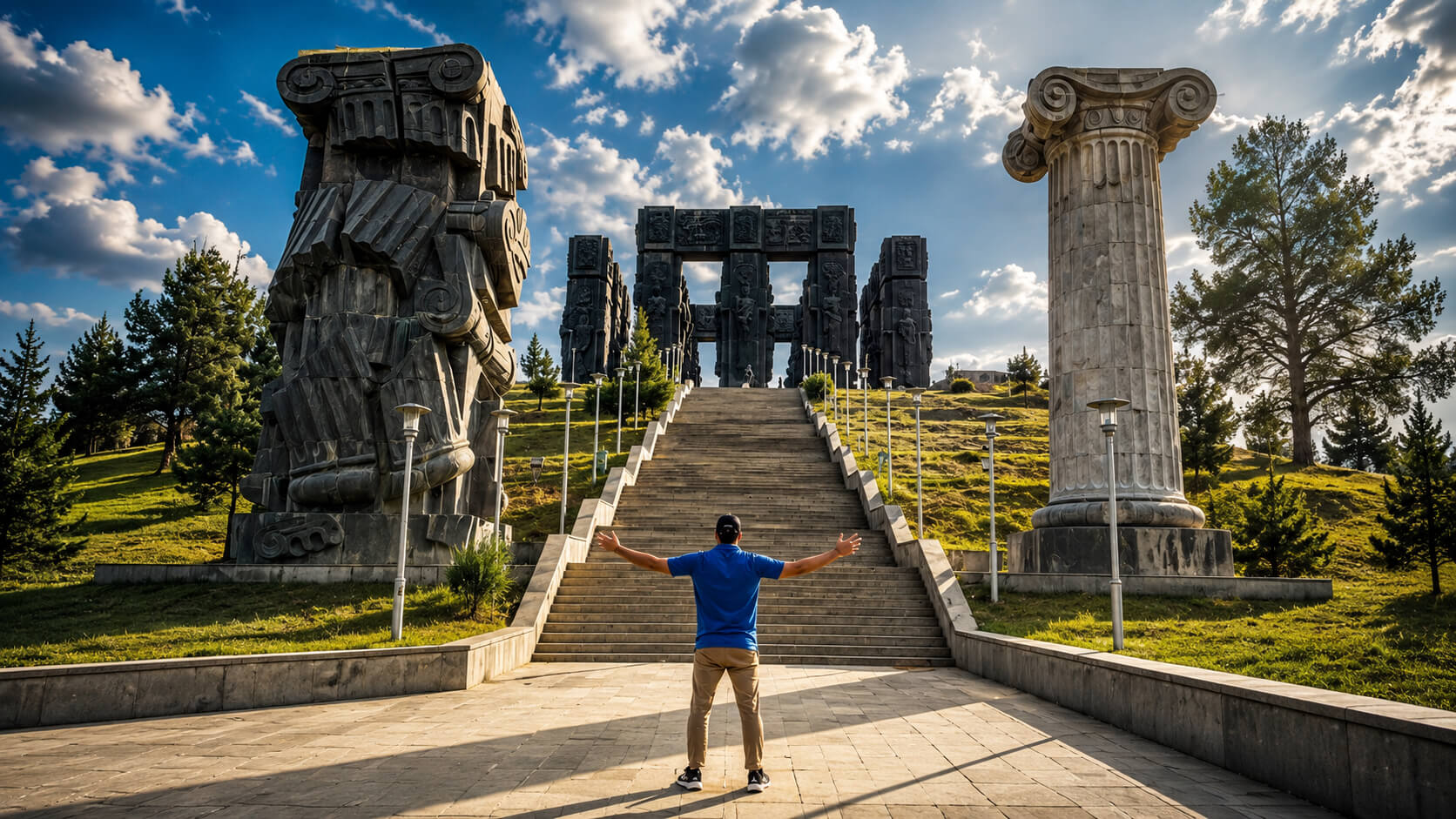
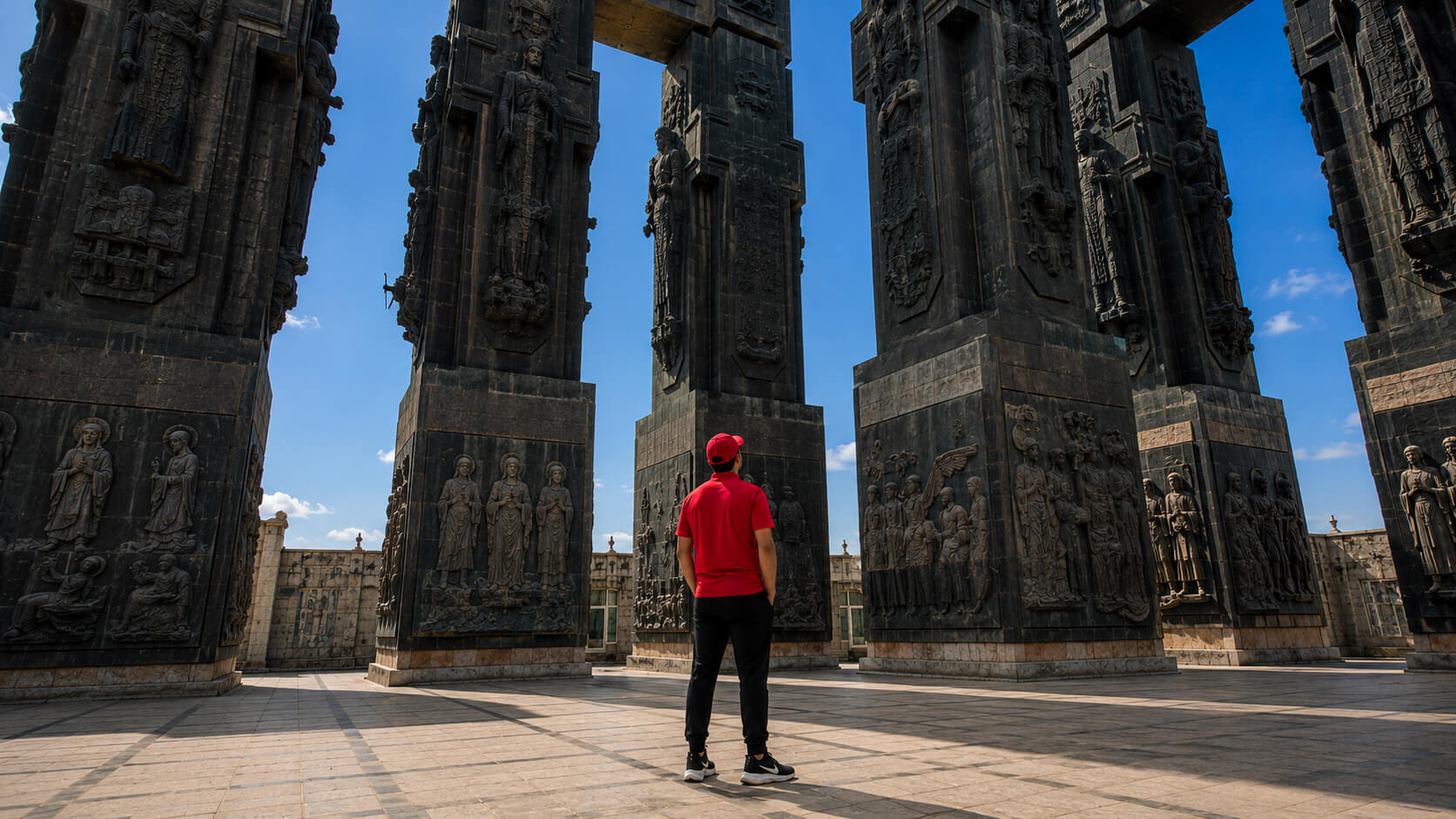
The monument consists of 16 freestanding pillars rising from an open plaza. Often referred to by travelers as the ‘Tbilisi Stonehenge’, every surface is clad in detailed bronze panels showing kings on horses, saints with halos, warriors, and ordinary Georgians across centuries of history. The scale hits you when you stand at the base and look up—the figures are life-sized or larger and cover every inch of metal. This is something you walk around, touch the textured surfaces, and experience up close.
Getting There From Tbilisi
- By car or Bolt: 20–25 minutes from city center, around 15–20 GEL
- By public transit: Take the Metro to Ghrmaghele or Sarajishvili station, then catch bus 360 or 394 heading toward Temka
- Best time: Before 9am or near sunset. The light is clean, avoiding mid-day crowds, with panoramic views over the Tbilisi Sea.
- Parking: Free parking lot at the base of the main staircase
Leave Tbilisi early. A Bolt from the city center takes 20–25 minutes and costs very little. The parking lot sits directly below the monument and you walk up the main staircase to the plaza in a couple of minutes. The early morning light at 7:30–8:30am hits the panels cleanly without harsh shadows. By late morning the sun flattens the details, and the wind picks up across the reservoir.
Tip
- Arrive by 8:30am for the best light on the main pillars
- Bring water and a light jacket—the hilltop plateau is highly exposed and wind can be strong
- The stone steps and plaza require comfortable walking shoes
The 16 Pillars: How the History is Structured
- Bottom section: Biblical narratives covering the New Testament and the life of Christ
- Middle section: Prominent historical Georgian royalty, monarchs, heroes, and saints
- Top section: Significant social events, secular history, and cultural achievements
- Reading the panels: Figures are identified on stone blocks at the base, alongside a nearby chapel and a giant vine cross
The 16 Pillars use a vertical narrative system. The lower tiers anchor the structure in faith, depicting the life of Jesus Christ. The middle levels celebrate the rulers, queens, and saints that defined the Golden Age of Georgia, such as Queen Tamar and King Mirian III. The top levels highlight historical events and literary milestones. The metal reliefs are remarkably detailed—from the expression of a warrior to the folds of a robe, each panel holds deep cultural intention.
Tip
- The identifying markers are lower to the ground, so using your phone camera to zoom in helps read descriptions easily
- The metal panels catch light differently throughout the day, altering the mood and visual depth of the panels
Photography: Every Angle Worth Having
- Wide shots: Capturing the full columns grid with a person for an epic scale reference
- Detail shots: Focusing tightly on individual bronze faces, hands, and textured metal layers
- Architectural lines: The geometric pathways between pillars showing how the structures align
- Light dynamics: Side lighting from early morning or late afternoon cuts deep shadows that emphasize relief details
The monument offers wildly different frames depending on your vantage point. Looking up from the staircase, the towering pillars cut cleanly into the sky. Moving between the rows creates dramatic geometric lines and textures, where every chisel and cast line shows up clearly under directional morning sun. Avoid noon shooting when harsh overhead light flattens the deep reliefs.
Tip
- Wide angle (16–24mm): Frame the full layout with a person in the foreground to convey the scale
- Telephoto zoom: Isolate high-tier historical figures without losing crisp structural context
- Tbilisi Sea backdrop: Turn around at the edge of the plaza to catch wide panoramic shots of the vast reservoir below
- Avoid standard golden hour rules: Crisp morning light works best here because direct side angles maximize the depth of the reliefs rather than just washing them in overall warmth
How Long to Spend Here
- Quick stop: 45 minutes—a brisk walk through the plaza, quick photos, and exit
- Standard visit: 1.5–2 hours—enough time to read the panels, explore the chapel, and photograph thoroughly
- Extended visit: 3+ hours—ideal for history buffs or creatives wishing to sketch and study the intricate reliefs
Ninety minutes is the sweet spot for an independent trip. That allows a relaxed opening walkthrough to absorb the sheer scale, followed by dedicated time for Photography and viewing the individual stories. The monument reveals its complexity slowly; a rushed visit leaves you missing the subtle historical layers embedded in the upper sections.
Exploring Beyond the Monument: Brief Context
- Mtskheta & Svetitskhoveli Cathedral: 20 km north of Tbilisi—the spiritual cradle of Georgian Christianity, perfect for a half-day trip
- Gori Fortress: 80 km west—a historic medieval citadel overlooking the city, great for extended history loops
- Vardzia Cave Monastery: 300 km south—a spectacular 12th-century complex carved entirely out of a cliff face
The Chronicle of Georgia serves as a majestic architectural overview of the country’s legacy. However, that history comes alive when visiting the physical locations. Pair your morning at the monument with an afternoon trip to historic Mtskheta to see where these legends originally unfolded.
The Morning Trip Worth Taking
Leave your hotel at 7:00am, take a Bolt to the Chronicle of Georgia by 7:30am, explore the spectacular pillars until 9:30am, and head back into the city center for breakfast by 10:30am. This easy three-hour loop rewards you with incredible, crowd-free photography and an unrivaled architectural overview of Georgia’s historic soul.